Why Are Shooting Ranges Switching to Lead-Free Training Ammunition?
Posted by Roland Polzin on Aug 29th 2026
Last verified: August 29, 2026. General information for range operators, not legal or industrial hygiene advice.
Fifty micrograms per cubic meter, averaged over eight hours. That is the federal OSHA permissible exposure limit for airborne lead, and an indoor range is a workplace like any other. Most operators know that number. Fewer have registered that in California, since January 1, 2025, the limit is ten and the action level dropped from thirty to two. The standard did not tighten slightly. It moved by 80 and 93 percent.
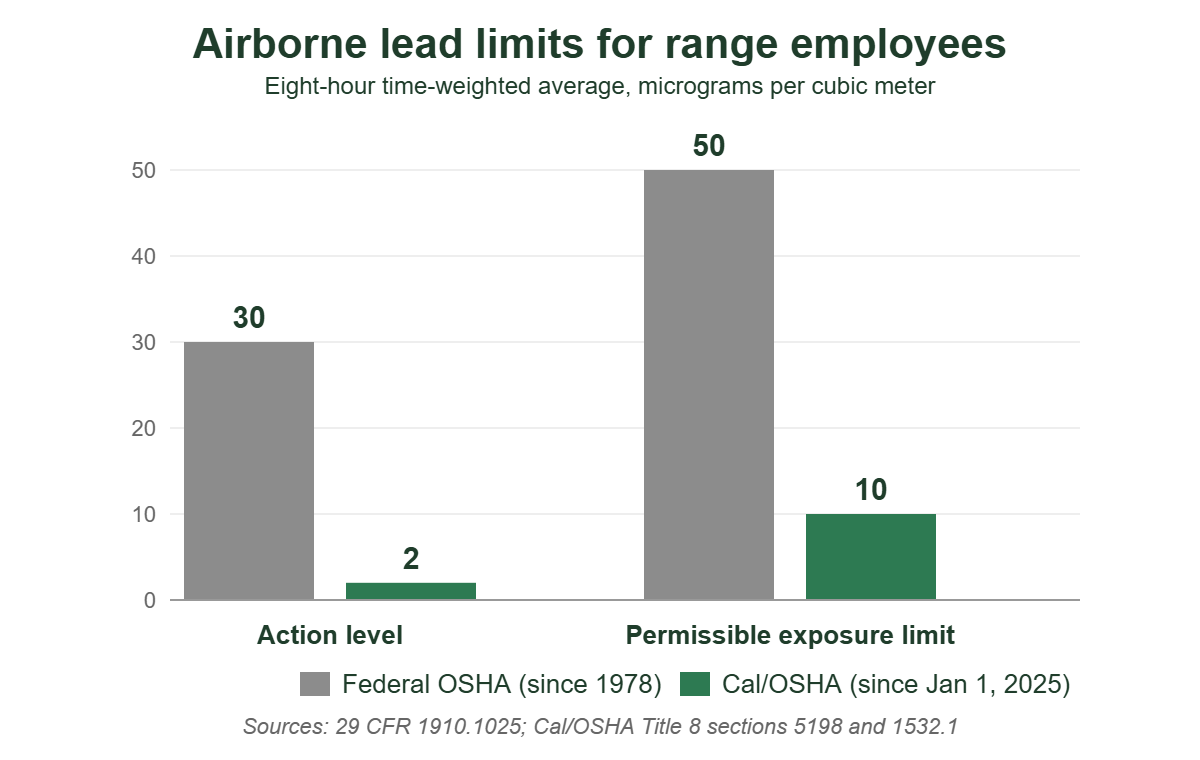
That is why the conversation about training ammunition changed. Ventilation dilutes airborne lead after it exists. It does not stop the round from making it.
On this page: What federal OSHA requires · What a citation costs · What California changed · Where range lead comes from · What the ammunition changes · Running the numbers · Switching selectively · Where to start · FAQ
What federal OSHA requires of a shooting range
The rule is 29 CFR 1910.1025, and OSHA publishes a fact sheet written specifically for indoor firing ranges. Everything starts with an initial determination of employee airborne exposure. Two thresholds then drive the obligations, both as eight-hour time-weighted averages in the employee's breathing zone:
| Threshold | Federal OSHA | Cal/OSHA since January 1, 2025 | What it triggers |
|---|---|---|---|
| Action level | 30 µg/m³ | 2 µg/m³ | Air monitoring, medical surveillance and blood lead testing, training, signage |
| Permissible exposure limit | 50 µg/m³ | 10 µg/m³ | Engineering and administrative controls, respiratory protection, written compliance program, protective clothing, hygiene facilities |
Two points operators miss. First, the obligation attaches the moment monitoring shows you are over, not at some future compliance date. Second, the standard protects employees. Your range officers, instructors, and cleaning staff are in that air forty hours a week; a member is there for ninety minutes. OSHA has nothing to say about your members, which does not mean nobody does. Customer exposure is a liability and reputation question, and it is the one that shows up in online reviews.
What a citation actually costs
Federal maximums for 2026: $16,550 per serious or other-than-serious violation, $16,550 per day for failure to abate past the deadline, and $165,514 per willful or repeated violation. There was no inflation adjustment this year, so the January 2025 amounts carried forward. Penalties are assessed per violation, not per inspection, and a single lead inspection can generate several.
Two things work in a small operator's favor. OSHA recently expanded its small-business reductions: employers with up to 25 employees now qualify for size-based reductions, and the 80 percent reduction for certain violations reaches employers with 20 or fewer. A documented, functioning safety program also qualifies for a meaningful good-faith reduction. The gap between a range with a written lead program and one without is not a rounding error. Current figures are on OSHA's penalties page.
State plan states set their own amounts, which must be at least as effective as federal.
What California changed, and why it matters outside California
Cal/OSHA replaced a standard that had stood since 1978. Along with the air limits above, the blood lead thresholds moved: medical removal now triggers at 30 µg/dL instead of 50, and return to the work area requires 15 µg/dL instead of 40, with a further tightening in 2026 using an averaging test at 20 µg/dL. NIOSH has considered blood lead levels well below OSHA's removal trigger elevated for years; the regulatory floor and the medical view of harm are not the same.
A California range that was comfortably compliant in 2024 can be over the action level today without one thing changing in the building. The practical instruction is narrow: re-run exposure monitoring against the new numbers rather than relying on older results. NSSF published a walkthrough written for range owners.
Ranges elsewhere should watch this for one reason: the federal numbers date to 1978, and state plans have historically converged over time. We are not predicting a federal change. We are saying the direction of travel is visible.
Where range lead actually comes from
OSHA's firing range guidance lists the sources. It is worth being honest that ammunition addresses some and not others:
- Lead-containing primer, which puts lead into the gun smoke at the firing line. Conventional primer compound is substantially lead styphnate. Ammunition addresses this.
- Lead is sheared from the projectile as it travels down the barrel, and deformation and fragmentation occur at the bullet trap. Ammunition partly addresses this.
- HVAC is never designed to capture lead particulate. Ventilation.
- Handling spent brass and cleaning firearms, which puts lead on hands and skin. Hygiene.
- Dry sweeping, compressed air, and non-HEPA vacuums, which put settled lead back into the air. Cleaning procedure.
- Recovering lead from traps and emptying bullet trays. Maintenance procedure.
Anyone selling you ammunition as a compliance solution is overselling. Two of six is worth having, and it is two you cannot fix with a better vacuum.
On the ventilation side, the benchmark most ranges are measured against is NIOSH's: an average of about 75 feet per minute at the firing line, with no individual point below roughly 50, air moving from behind the shooters downrange, and HEPA filtration on anything exhausted or recirculated. Trap design matters too. A granular rubber trap generates less fragmentation than a hard steel deflector, so two ranges shooting identical ammunition can monitor very differently.
What the ammunition changes
Our 9mm uses a lead-free primer, so there is no lead styphnate in the smoke at ignition. The projectile is a total metal jacket: the lead core is fully enclosed in copper, front and back. Hot gas doesn't strip anything off an open base on the way down the barrel, and less exposed lead deforms at the trap.
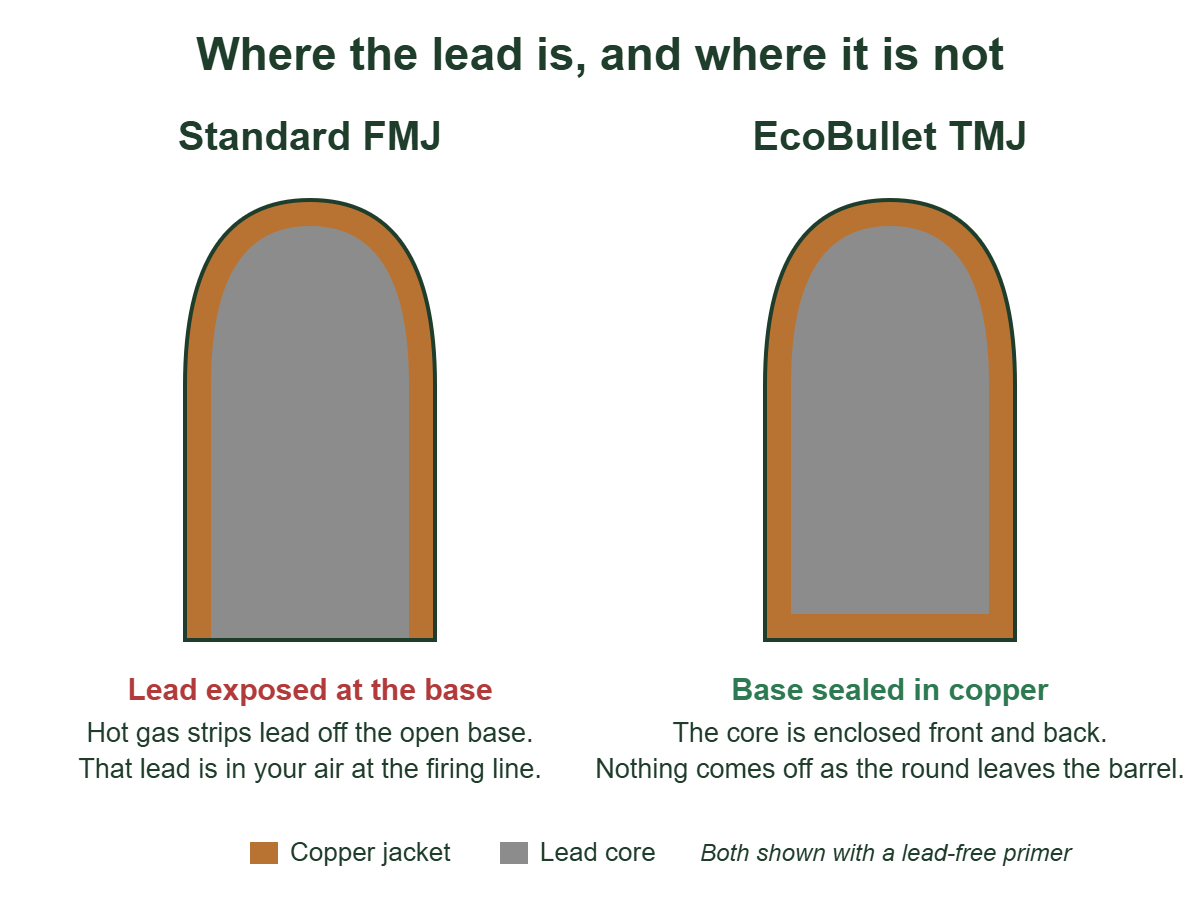
That is what Least-Lead-Exposure™ means. Less lead where your staff is breathing, not a claim that lead has left the building.
The other question every range asks is whether it runs. An independent reviewer tested our 115gr load in five handguns, from a 3" barrel to an 11", and published velocity and consistency data; the standard deviation came in comparable to common range brands. The detail is in our post on whether lead-free ammo is as reliable as standard ammo. For a rental line, function-test it in your own guns before committing to a pallet, exactly as you would with any new house load.
Running the numbers
Lead-free training ammunition costs more per round than commodity range ammo, and we will not pretend otherwise. Do the arithmetic first:
(lead-free price per round minus your current price per round) × rounds per month × 12 = the annual premium.
Our 9mm 115gr TMJ is $19.99 for 50, which is $0.40 a round at retail, and volume pricing is available. A range running 15,000 rounds a month at a 12-cent delta is looking at roughly $21,600 a year. That is a real number, and it deserves a real answer, not a slogan.
The other column is specific to your building, so have your EHS (environmental, health and safety) consultant price it rather than trusting a figure from a blog post: exposure monitoring, medical surveillance per exposed employee, respiratory protection program administration, and the capital cost of whatever ventilation work the monitoring triggers. Spent lead handling at the trap is its own line, with hazardous waste implications if it is done wrong, and lead management increasingly comes up in insurance underwriting and renewal conversations.
If your monitoring sits comfortably under the action level and your ventilation is modern, the premium is hard to justify on compliance grounds alone, and we would rather say that than sell you something you do not need. If you are near a threshold, or you are in California, the columns look different.
Most ranges switch selectively, not entirely
This is the part nobody writes about:
- Instructor and RSO ammunition first. They are on the line every day. They are also the employees whose blood gets tested.
- The worst bay. If one enclosed or under-ventilated bay drives your readings, target that bay rather than the whole facility.
- Classes and new-shooter courses. Concentrated round counts in a small area, often with an instructor standing beside the muzzle for hours.
- The retail shelf. Members who ask about lead will buy it themselves. That is a margin line rather than a cost line, and it answers the question when it comes up at the counter.
Starting with the instructor line is a fraction of the volume and most of the exposure benefit for the people the standard is actually about.
Where to start, in order
- Get current exposure monitoring. Everything else is guesswork without it, and California ranges relying on pre-2025 results are using the wrong numbers.
- Use the free help. OSHA's On-Site Consultation Program is free for small employers, separate from enforcement, and does not result in citations. NIOSH's Health Hazard Evaluation program also evaluates workplaces at no cost.
- Check your airflow against the NIOSH figures. A partially closed supply register has been enough to put a bay out of range in published evaluations.
- Fix procedure before buying anything. HEPA vacuums instead of dry sweeping, hygiene facilities, and trap-maintenance protocols are cheaper than both ammunition and ductwork.
- Then test ammunition on the highest-exposure line. Request a sample, function-test it in your own guns, and monitor before and after so you know what it bought you.
Frequently asked questions
What does OSHA require for lead at an indoor shooting range?
Under 29 CFR 1910.1025, ranges must conduct an initial determination of employees' airborne lead exposure. At or above the action level of 30 µg/m³, air monitoring and medical surveillance apply. Above the permissible exposure limit of 50 µg/m³, engineering controls, respiratory protection, a written compliance program, protective clothing, and hygiene facilities are required. OSHA publishes a fact sheet specifically for indoor firing ranges.
How much can an OSHA lead citation cost a shooting range?
For 2026, federal maximums are $16,550 per serious or other-than-serious violation, $16,550 per day for failure to abate, and $165,514 per willful or repeated violation. Penalties are per violation, not per inspection. Small employers and those with documented safety programs qualify for reductions, and OSHA recently expanded the small-business tiers.
Did California change its lead limits for shooting ranges?
Yes. Effective January 1, 2025, Cal/OSHA lowered the permissible exposure limit from 50 to 10 µg/m³ and the action level from 30 to 2 µg/m³, replacing a 1978 standard. Blood lead removal and return thresholds were also lowered, with further tightening in 2026. California ranges should re-run exposure monitoring against the new numbers rather than relying on older results.
Does lead-free ammunition replace ventilation and cleaning?
No. A lead-free primer removes lead generated at ignition, and a fully encapsulated core reduces lead sheared in the barrel and fragmented at the trap. Ventilation, HEPA cleaning procedure, backstop maintenance, and staff hygiene still carry the rest. Treat ammunition as one control among several, never as a substitute for the others.
What airflow should an indoor shooting range have?
NIOSH guidance is an average of roughly 75 feet per minute at the firing line, with no point below about 50, moving from behind the shooters downrange, and HEPA filtration on exhausted or recirculated air. Airflow is measured on an empty range. If your readings are high, verify airflow before assuming the problem is the ammunition.
Will lead-free ammunition run reliably in rental guns?
Our 115gr 9mm was independently tested in five handguns spanning 3" to 11" barrels, with velocity and consistency in line with common range loads. Details are in our reliability write-up. As with any new house load, function-test it in your own rental inventory before committing to volume.
Does the whole shooting range have to switch at once?
No, and most do not. Common starting points are instructor and range officer ammunition, the worst-ventilated bay, and new-shooter classes. That captures the highest-exposure situations at a fraction of the total volume.
How do we get bulk or wholesale pricing?
Contact us directly. We work with ranges and retailers on volume orders and can send a sample for function testing before you commit. Email info@ecobullet.us or call +1 423 445 0808.
EcoBullet is a veteran-founded, veteran-run company in Chattanooga, Tennessee. Our ammunition is made in the USA on recycled brass tracked by batch, with production emissions measured and offset. We stock 9mm 115gr and 124gr TMJ for pistol bays and .223 Remington and 300 Blackout for rifle lines. Ranges and retailers: email info@ecobullet.us, call +1 423 445 0808, or use our contact page for volume pricing and samples. Shipping to some states carries extra steps, covered in our state-by-state guide. Browse the full lineup.
Sources: OSHA 29 CFR 1910.1025 and OSHA's fact sheet on lead hazards at indoor firing ranges; OSHA penalty schedule; Cal/OSHA Title 8 sections 5198 and 1532.1 as amended effective January 1, 2025; NIOSH indoor firing range resources and published Health Hazard Evaluation reports. Verify current requirements with OSHA, your state plan, or your own EHS advisor before making compliance decisions.